Florida Landscape Trees & Shrubs
Popular trees and shrubs for South Florida landscapes, with growing zones and care tips. Page 6 of 6. Click or tap a photo to open it full size.
Bismarck Palm - Bismarckia nobilis
Non-native / Exotic
Family - Arecaceae
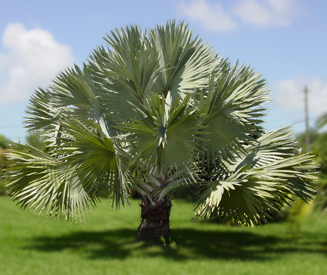
A single-trunked fan palm from Madagascar, grown for its huge, stiff, silver-blue leaves. Each rounded leaf can be 10 feet across on a stalk lined with small teeth, and a mature crown may spread 20 feet or more. A green-leaved form is also sold, but the silver form is far more common in Florida landscapes.
Bismarck palm grows slowly at first, then speeds up once its trunk forms, eventually reaching 30 to 50 feet in Florida. Male and female flowers are on separate trees; female palms carry hanging clusters of brown, olive-sized fruit.
Zones 10 - 11, with mature palms surviving brief dips into the upper 20s. Needs full sun and well drained soil, and is very drought tolerant once established, with moderate tolerance of salt air. Like many palms, it can show potassium and magnesium deficiencies on poor soils, so use a palm fertilizer.
Landscape use - A bold specimen palm for large lawns, commercial sites and wide medians. Its size is easy to underestimate in a nursery pot, so plant it well away from buildings, walkways and other trees. Large palms are difficult to transplant, so choose the spot carefully.
Tamarind - Tamarindus indica
Non-native / Exotic
Family - Fabaceae
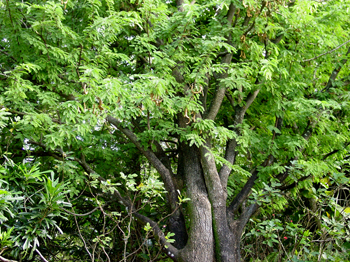
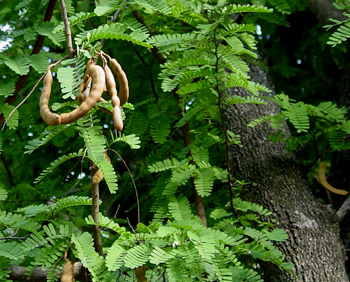
A large, long-lived evergreen tree from tropical Africa, grown in South Florida for shade and for its edible pods. Tamarind can reach 40 to 60 feet with a broad, rounded crown of fine, feathery leaves made up of many small leaflets that fold together at night.
Flower - Small, pale yellow flowers streaked with red appear in loose clusters in late spring and summer. They are followed by thick, curved, cinnamon-brown pods 3 to 8 inches long. Inside, a sticky brown pulp surrounds the shiny seeds; the sweet-sour pulp is used in drinks, sauces, chutneys and candy.
Zones 10 - 11; young trees are damaged by frost, though older trees handle brief cold better. Tamarind grows in full sun on a wide range of well drained soils, including sand and limestone, and is very drought tolerant with moderate salt tolerance. Its strong, flexible wood stands up well to high winds.
Landscape use - Shade tree, specimen or fruit tree for large yards. Growth is slow to moderate, and seedlings can take many years to bear, so grafted trees are preferred for fruit. Fallen pods and leaves create some litter near patios and driveways.
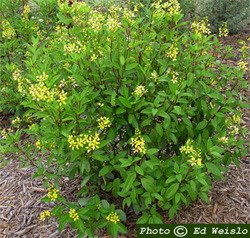
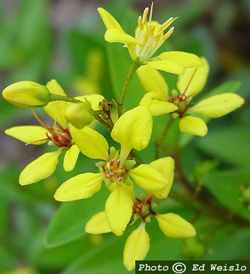
Thryallis, Rain-of-Gold - Galphimia gracilis
Non-native / Exotic
Family - Malpighiaceae
Long sold as Galphimia glauca, the thryallis grown in Florida landscapes is now recognized as a different species, Galphimia gracilis.
A rounded, evergreen shrub from Mexico and Central America that is covered most of the year with small, bright yellow, star-shaped flowers held in upright clusters at the branch tips. Left unpruned it grows 5 to 9 feet tall and somewhat narrower, with slender reddish stems and small, oval, light green leaves.
Zones 9b - 11. A freeze kills it back, but it usually regrows from the base. Thryallis flowers best in full sun and grows in most well drained soils, though leaves may yellow on very alkaline soil. It has moderate drought tolerance once established but little tolerance of salt, so keep it away from the beachfront.
Landscape use - Informal hedges, borders, foundation plantings and mixed beds where a long season of yellow color is wanted. Its loose, open habit suits informal plantings; light pruning keeps it full. Bees visit the flowers, and few pests bother it.
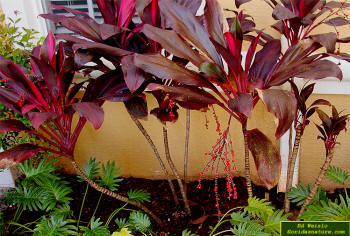
Ti Plant, Good-luck Plant - Cordyline fruticosa
Non-native / Exotic
Family - Asparagaceae
Formerly Cordyline terminalis, in the agave family (Agavaceae).
An upright, cane-forming shrub native to Southeast Asia and the western Pacific, carried across Polynesia by early voyagers and still important in Hawaiian culture. Leaves are long, glossy and strap-shaped, crowded in spirals at the top of slender stems. Countless cultivars offer foliage in green, red, burgundy, pink, cream and near-black, often striped or edged in a contrasting color.
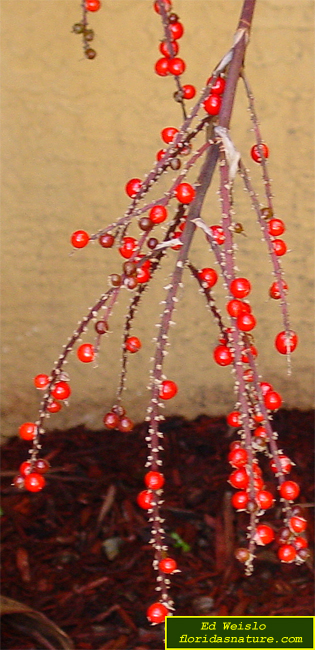
Flower - Branched sprays of small, fragrant, white to lavender flowers appear in winter on mature plants, sometimes followed by bright red berries.
Zones 10 - 11; cold below about 40°F damages the leaves. Ti plant grows 6 to 10 feet tall but is usually kept shorter. Most varieties color best in bright, filtered light or partial shade, and full sun can scorch them. It prefers moist, rich, well drained soil, has little drought or salt tolerance, and can be sensitive to fluoride in water and fertilizer.
Landscape use - Accent plant, tropical beds, containers and narrow spaces. Cut stems root easily, and tall, leggy canes can be cut back to make the plant branch.
Toxic to pets: Ti plant contains saponins that can cause vomiting (sometimes with blood), drooling, depression and loss of appetite in dogs and cats, and dilated pupils in cats. If your pet chews or eats the plant, call your veterinarian or the ASPCA Animal Poison Control Center at (888) 426-4435 (a fee may apply). If a person eats it and becomes ill, call Poison Control at 1-800-222-1222 or seek emergency care.
Varnishleaf, Florida Hopbush - Dodonaea viscosa
Native
Family - Sapindaceae
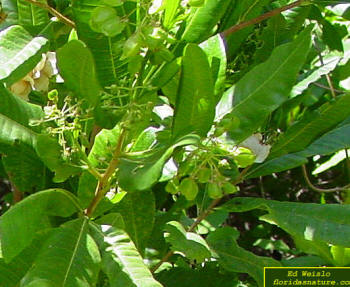
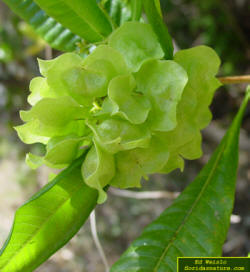
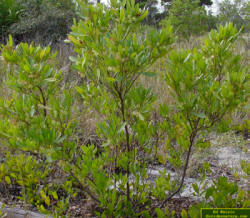
A tough evergreen shrub or small tree, native to coastal hammocks, dunes, pinelands and shell mounds in Central and South Florida and found in warm regions around the world. It usually grows 6 to 15 feet tall. The narrow, bright green leaves are coated with a sticky resin that makes them look freshly varnished, which gives the plant its common name.
Flower - Small greenish-yellow flowers are easy to overlook, but the fruit that follows is showy: clusters of papery capsules with two to four thin wings that turn pink, red or tan and resemble hops. Male and female flowers are usually on separate plants, so only females produce the decorative capsules.
Zones 9 - 11. Varnishleaf needs full sun to light shade and fast-draining sandy or rocky soil. It is highly tolerant of salt spray, drought and wind, making it one of the best native shrubs for seaside gardens.
Landscape use - Hedges, screens, windbreaks and naturalistic coastal plantings. It responds well to shearing for a formal hedge or can be left to grow into a small, multi-trunked tree. Bronze or purple-leaved selections sold in nurseries are usually forms from outside Florida, so choose local stock if you want the native plant.
See also the full native-plant entry on Native Trees & Shrubs, page 6.
White Bird-of-Paradise - Strelitzia nicolai
Non-native / Exotic
Family - Strelitziaceae
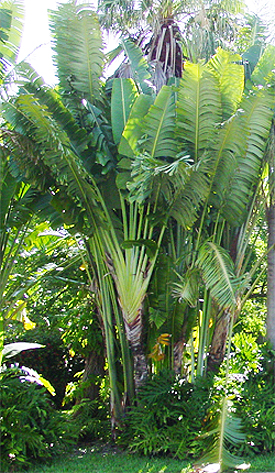
The giant relative of the bird of paradise on page 1, native to coastal forests of southeastern Africa. It forms clumps of trunk-like stems 15 to 30 feet tall, topped by fans of huge, banana-like leaves up to 6 feet long that often split in the wind.
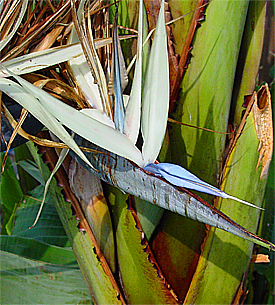
Flower - The flowers emerge from stiff, boat-shaped bracts of dark blue-gray to nearly black, with white sepals and a blue, arrow-shaped tongue, giving the look of a large bird's head. They form deep in the leaf bases, mostly in warm weather, and drip sticky nectar.
Zones 9b - 11; frost damages the leaves, but established clumps usually recover. Grows in full sun to partial shade on most well drained soils, with good drought tolerance and moderate salt tolerance once established. Regular water and fertilizer give the lushest look.
Landscape use - A fast tropical screen or specimen and a substitute for bananas where fruit isn't wanted. Plan for its size: clumps widen steadily from new shoots at the base, and the large leaves need grooming to remove brown, shredded leaves and old flower stalks. Avoid planting close to pools, walls or foundations.
Mandevilla - Mandevilla spp.
Non-native / Exotic
Family - Apocynaceae
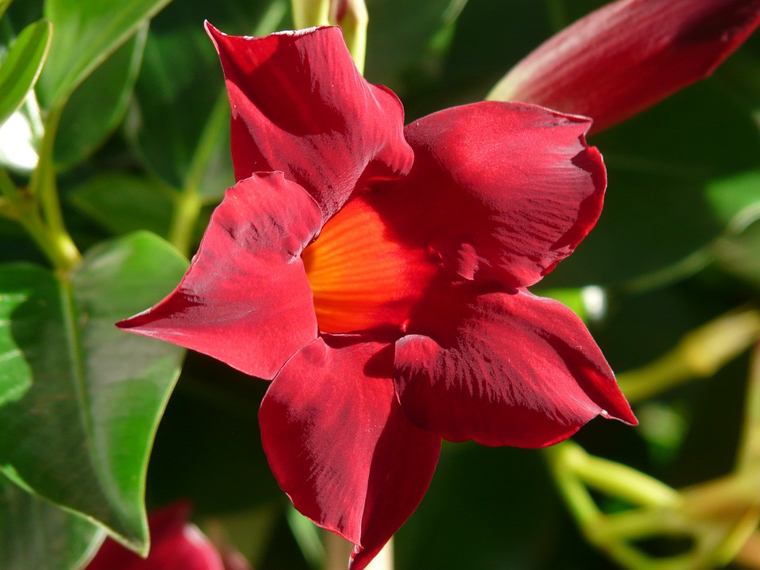
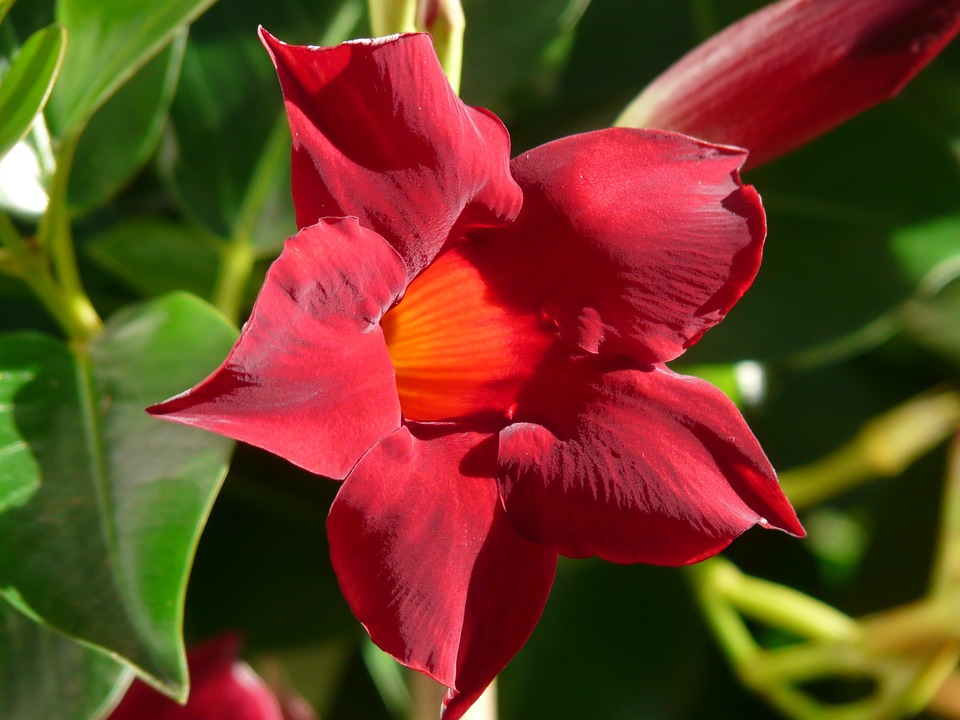
A twining evergreen vine from tropical Central and South America, grown for its large, funnel-shaped flowers. The five broad, slightly twisted petals open from a narrow tube and come in red, pink, white and bicolors, often with a yellow or orange throat. Most plants sold in Florida are hybrids, including the long-popular pink 'Alice du Pont' and compact series bred for pots and hanging baskets.
Mandevilla is sometimes called pink allamanda, but it belongs to a different genus in the same dogbane family. The leaves are opposite, glossy, dark green and oval with a pointed tip, and the stems ooze a milky sap when cut, which can irritate sensitive skin.
Zones 10 - 11, and it survives in protected spots in zone 9b. Light frost damages the leaves, so in colder areas it is grown as a summer annual or brought indoors for winter. Flowers best in full sun to light afternoon shade, blooming from spring into fall and nearly year-round in South Florida.
Plant in rich, well drained soil and water regularly until established; mature plants are moderately drought tolerant. Leaves may yellow (chlorosis) on alkaline soils, which a slightly acidic fertilizer helps correct. Salt tolerance is low, so keep it away from direct salt spray.
Landscape use - Trellises, arbors, fences, mailbox posts and containers. Most hybrids climb 10 to 20 feet if given support but can be pinched to stay bushier. Watch for mealybugs, scale and spider mites, especially on plants kept indoors over winter.